
The Challenge
Engineering held unfinished solid CAD for a complex hardware prototype. The geometry described a fluid-dynamics device, but it did not explain the device. Internal motion, process order, and the reason the mechanism mattered stayed invisible inside dense solids that a game engine could not run and an executive audience could not read.
The firm needed one film that carried three jobs at once: show core function, state the value proposition, and give leadership a feasibility artifact they could screen internally and with investors. Voiceover and caption copy would come from the engineering team. Everything else — models, simulation, capture, edit, annotation — had to come from a single contractor.
I bid that scope before production started. The estimate collapsed four production seats into one owner: product storyboard, 3D modeling, Unreal Engine 4 development, and picture finishing. I set a 200-hour baseline, a 240-hour ceiling for rendering and tooling bottlenecks, and a fixed price through that ceiling. Phase gates required engineering review before the next stage opened. That forecast was the risk control. Hardware limits, mesh cost, Blueprint complexity, and capture throughput were named in the bid, not discovered at the deadline.
The Architecture & Pipeline
Each phase closed on a reviewable artifact. Engineering signed the gate. I carried the asset forward.
Phase 1: Ingestion & Alignment
I sat with the core engineering team and extracted the value proposition from the mechanism itself: what moves, in what order, and what an investor must see to believe the system works. Storyboard flows (Sketch, Photoshop, Illustrator) locked scene order before any mesh work began, including future form-factor studies so the simulation would not freeze an unfinished industrial design.
In parallel I specified and built a dedicated digital-media workstation against Unreal Engine 4's GPU floor. The bid required a discrete NVIDIA-class card at or above the engine minimum, with a faster NVIDIA GPU (GTX 660 / GTX 750 Ti class or higher) held in reserve for dense solids, viewport capture, and particle load. Unfinished CAD does not survive a laptop GPU. The workstation existed so ingestion, re-mesh, and real-time preview could run on one machine without a render-farm handoff.
Gate: approved storyboard and a reusable UE4 component set.
Phase 2: Asset Generation (Blender)
I deconstructed the raw CAD. Solids that were correct for engineering were wrong for real time: uncontrolled triangle counts, non-manifold joins, and materials with no game-engine equivalent. I re-meshed the assemblies, rebuilt primitives where the source mesh would not deform or instance cleanly, and assigned first-pass textures and light-mass proxies so every part imported as a stable UE4 static or skeletal mesh.
Gate: captured stills and motion tests of the optimized models.
Artifact: UE4-importable geometry of the proprietary mechanical system.
Phase 3: Cyber-Physical Simulation (Unreal Engine 4)
I imported the optimized assets into a dedicated UE4 map and built the runtime, not a pre-render.
- Rigged mechanical components so motion followed the engineering sequence.
- Authored Blueprints for event-based triggers: process start, state changes, and camera cues.
- Lit the interior so occluded volumes read on screen.
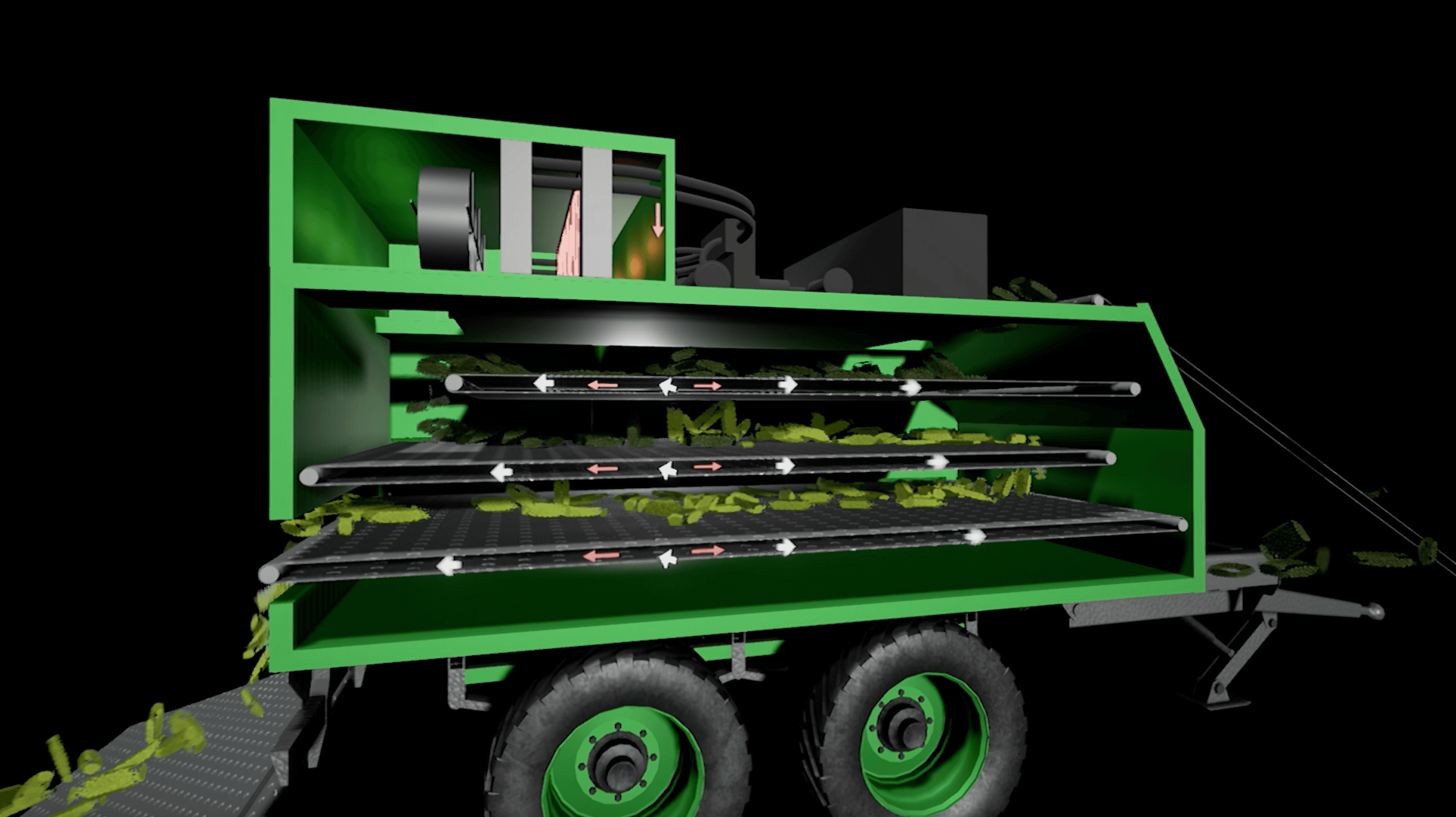
- Drove particle and material systems that stand in for the physics the CAD never drew — flow, transfer, and the path through the device.
- Rigged cameras for repeatable viewport coverage of the same beats the storyboard defined.
The simulation shipped as a runnable map. Reviewers could scrub it live or watch an mp4 of that same runtime. That split mattered: the film is evidence of a working real-time system, not an offline illustration of one.
Gate: live simulation plus in-engine recordings.
Artifact: completed UE4 map.
Phase 4: Cinematic Capture (FRAPS) & Narrative Sequencing (Premiere Pro)
I captured high-fidelity viewport footage with FRAPS so the recorded frames were the simulation, including lighting, particles, and triggered motion. Premiere Pro then cut that footage to the storyboard. Pacing, shot order, and the handoff between mechanism beats were locked here, before any graphic layer competed with the picture.
Gate: assembly cut with engineering on story order.
Phase 5: Epistemic Annotation (After Effects)
I overlaid the annotation system in After Effects: motion-graphic callouts, feature descriptors, and on-screen labels timed to the mechanical events. The engineering team supplied voiceover and caption text. I timed, designed, and placed the graphics so each invisible step inside the fluid-dynamics device had a visible name at the frame it occurred. The annotations explain the simulation. They do not decorate it.
Gate: annotated picture locked to the simulation beats.
Phase 6: Final Delivery
I returned to Premiere Pro, integrated the firm's corporate branding, mixed the supplied voiceover against the captured simulation audio, and delivered the 4.5-minute film. A final screening included a scheduled polish window. Clear deliverables across the contract were the mockups, the UE4-ready models, the completed simulation map with recordings, and the finished concept film. A contingency of up to 40 hours remained available after delivery for executive-presentation tweaks, outside the 240-hour production ceiling.
The Outcome
Leadership received a 4.5-minute film that makes the internal process of a proprietary mechanical system readable. Unfinished CAD entered one end of the pipeline. A runtime UE4 simulation and an executive cut came out the other.
The contract proved the forecast. One person bid, staffed, and shipped the seats the scope actually required — modeler, simulation developer, storyboarder, and picture editor — inside a 200-hour baseline on a 3-month engagement. Bottlenecks were priced before they appeared: GPU class, mesh compatibility, Blueprint-driven events, and capture from the live viewport. Investors and the internal team could see the mechanism work, in order, with the physics labeled. That alignment was the product.